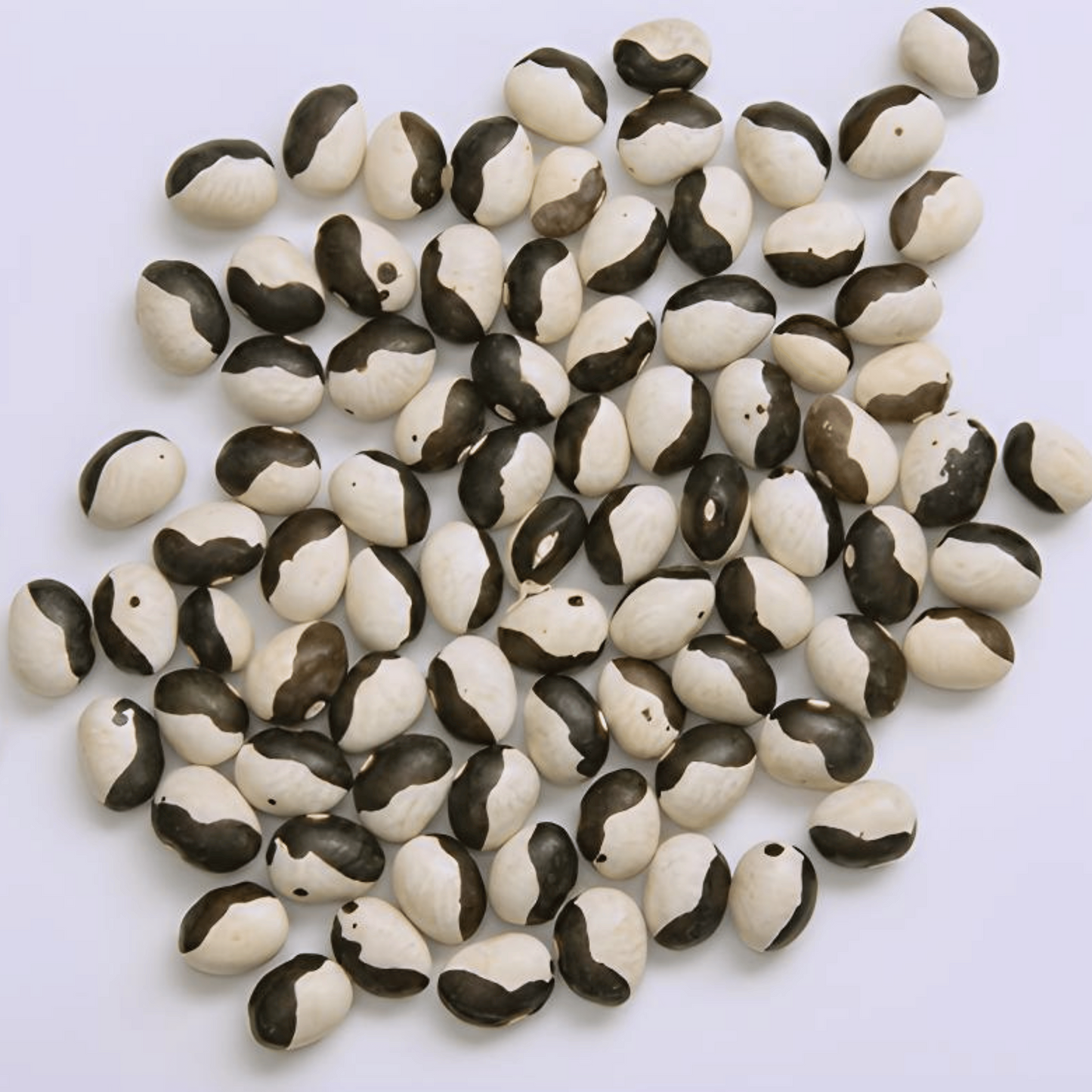
Calypso Orca Bean (Bush) | 25 Seeds
Calypso Orca Bean (Bush) | 25 Seeds
Couldn't load pickup availability
Share
Calypso Orca Bean (Bush) | 25 Seeds
CLASSIFICATION: Phaseolus vulgaris (Heirloom) PATTERN: High-Contrast | Black & White TEXTURE: Potato-Like | Creamy HABIT: Bush (Self-Supporting)
Most legumes are visually apologetic, fading into the background in shades of beige or mud. The Calypso Bean is an exercise in high-contrast graphic design.
Often referred to as the "Orca" or "Yin-Yang" bean due to its stark black-and-white markings, this heirloom brings a rigorous, monochromatic aesthetic to the vegetable patch. It does not look organic; it looks painted.
But this is not merely a visual stunt. The Calypso is a culinary heavyweight. Unlike lesser beans that dissolve into mush, it maintains its structural integrity when cooked, offering a creamy, potato-like texture that makes it a luxury ingredient for stews rather than just a filler.
________________________________________
THE CURATOR'S NOTES
- Structural Integrity: In the construction world, we value materials that hold their form under pressure. In the kitchen, the Calypso does the same. It refuses to disintegrate during long simmers, providing a distinct, satisfying bite in soups and chowders.
- The Flavor Profile: It possesses a distinct richness often compared to a potato. It is substantial enough to anchor a meal without meat.
- Pantry Aesthetics: Even before cooking, they serve a purpose. Stored in a clear glass jar, a pound of Calypso beans functions as a piece of modern art on the countertop. They are too graphic to hide in a cupboard.
- The "Bush" Advantage: This plant respects your lack of infrastructure. It is a bush variety, meaning it is self-supporting and compact. It requires no trellis, no poles, and no complex engineering to grow.
- Harvest Protocol: While they can be eaten fresh, their true destiny is the dry bean. Let the pods wither on the plant until they rattle, then harvest for a winter supply of monochromatic sustenance.